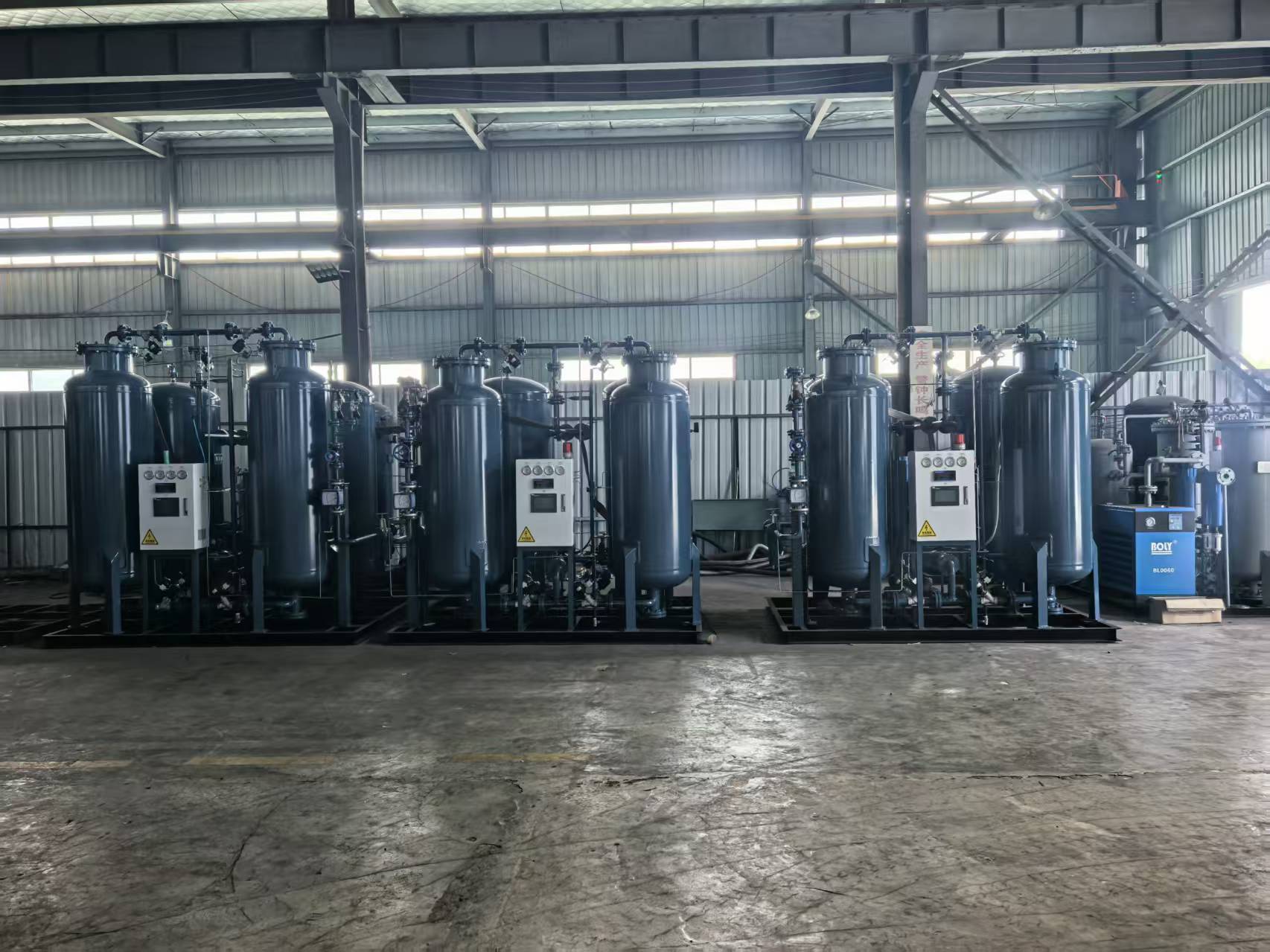
Pressure Swing Adsorption (PSA) is a gas separation and purification technology based on the selective adsorption characteristics of porous adsorbents under different pressures.
Its core principle can be summarized as follows:
-
Selective Adsorption
Adsorbents (such as activated alumina, molecular sieves, activated carbon, etc.) have different adsorption capacities for various gas components. Under a certain pressure, components with strong adsorption affinity (e.g., water vapor, CO₂, nitrogen, or heavy hydrocarbons) are preferentially adsorbed onto the adsorbent surface, while weakly adsorbed components (e.g., hydrogen, oxygen) pass through and are collected as product gas.
-
Pressure Swing Effect
The adsorption amount of gas on the adsorbent
increases with rising pressure and
decreases with falling pressure.
- During the adsorption stage (high pressure): Impurity components are adsorbed, separating the target gas.
- During the desorption/regeneration stage (low pressure or vacuum): The adsorbed impurities are released due to reduced pressure, allowing the adsorbent to be regenerated and reused.
- Cyclic Operation
PSA systems typically use multiple adsorption beds operating alternately to realize continuous gas production through repeated cycles of adsorption → pressure equalization → depressurization/desorption → purging → repressurization.
In short, PSA achieves efficient gas separation by utilizing the
pressure-dependent adsorption behavior and
component selectivity of solid adsorbents.